Blog
China Top 10 Warning Light Manufacturers?
Choosing a reliable Warning Light Manufacturer in China requires more than comparing product photos or factory prices. Warning lights support safety communication in warehouses, construction zones, emergency vehicles, industrial machinery, and transport systems. Their performance can affect visibility, response time, and equipment protection.
This guide examines ten notable Chinese manufacturers through practical criteria. These include optical brightness, flash patterns, weather resistance, mounting options, production capacity, quality control, and after-sales support. Certifications and test reports also matter. A strong supplier should explain its materials, wiring methods, operating temperatures, and ingress protection ratings clearly.
Details reveal the difference.
For example, a warning light may appear bright in a showroom but perform poorly under sunlight or heavy rain. Buyers should request samples, inspect lens quality, test connectors, and confirm actual delivery schedules. Factory experience is useful, but it does not guarantee every product fits every application. That point is easy to overlook.
The manufacturers discussed here represent different strengths, such as LED engineering, custom design, export experience, or small-batch flexibility. However, a ranking should remain practical rather than absolute. Prices, certifications, production lines, and service policies can change over time. Independent verification is still necessary before signing a contract.
This overview aims to help importers, engineers, distributors, and project managers make better decisions. It focuses on evidence, usability, and long-term reliability instead of promotional language. Some suppliers may look impressive on paper, yet sample testing may reveal limitations. That is why careful comparison remains essential.
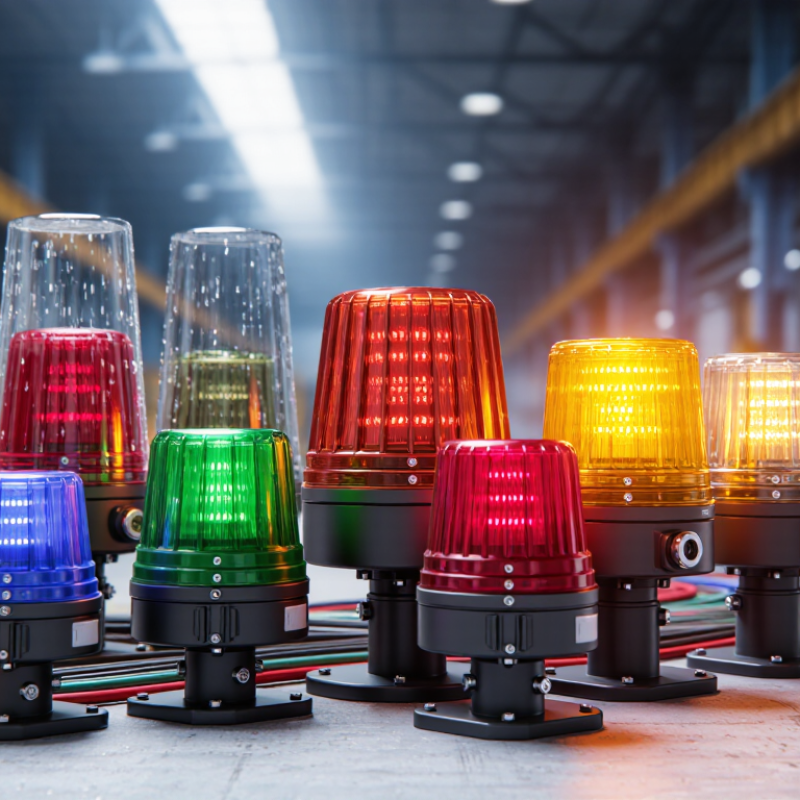
What Are Warning Lights and Why Are They Important?
Warning lights are visual or audible devices that signal danger, equipment status, or urgent action. They appear on factory machines, vehicles, control panels, and public safety systems. Their colors, flash patterns, and sound levels help people understand conditions quickly. A red light may indicate an immediate hazard, while amber often suggests caution or a changing operating state.
Their importance becomes clear in noisy workshops and poorly lit outdoor areas. A clear signal can stop a worker before a moving part causes injury. It can also warn drivers about restricted zones, reversing vehicles, or sudden equipment faults. Good warning lights remain visible through dust, rain, vibration, and changing daylight. Brightness matters, but excessive glare can create another problem.
Reliable selection requires practical testing, not attractive specifications alone. Check the viewing angle, operating voltage, mounting method, enclosure protection, and expected service life. Confirm that the product suits the equipment and applicable workplace standards. Test the light under real conditions, including direct sunlight and electrical fluctuations. No warning device is perfect. A lamp may pass a bench test yet become unclear behind tinted glass. Regular inspections and clear maintenance records help reveal these weaknesses before they become serious.
How China’s Warning Light Manufacturing Industry Is Structured
China’s warning light manufacturing industry is not one uniform market. It is a layered supply chain. Large factories usually produce optical modules, housings, circuit boards, and complete signal units. Smaller workshops often handle wiring, molding, assembly, or customized orders. This structure supports flexible pricing, but quality can vary between batches. The China National Bureau of Statistics reported that manufacturing contributed about 31.6% of global manufacturing value added in 2023. That scale gives local suppliers strong access to components and production equipment.
Demand comes from several channels. Industrial automation requires stack lights, beacons, and machine-status indicators. Transport equipment uses warning lamps for visibility and operational safety. The China Association of Automobile Manufacturers reported China produced more than 30 million vehicles in 2023. That figure shows the depth of the related component ecosystem, although vehicle demand does not represent the whole warning light market. Export-oriented suppliers often divide into three groups: standardized producers, engineering-focused manufacturers, and trading-led integrators. Their testing systems, documentation, and after-sales skills may differ widely. I have found that the cheapest quotation is rarely the clearest one.
Tips: Check luminous intensity, ingress protection, operating temperature, wiring diagrams, and test records. Ask for a sample from the intended production line. Confirm whether the quoted data comes from laboratory testing or field experience. Industry reports can guide market size, but they cannot replace a factory audit. A practical review should examine traceability, aging tests, connector quality, and response time. Small details matter.
China Top 10 Warning Light Manufacturers? How China’s Warning Light Manufacturing Industry Is Structured
China’s warning-light manufacturing industry is mainly structured around LED, incandescent, halogen, and xenon technologies. LED products dominate modern industrial, traffic, construction, and vehicle applications because of their longer service life, lower energy consumption, and flexible optical designs.
The figures show typical service-life values commonly specified for each lighting technology. Actual performance varies according to operating conditions, duty cycle, thermal management, and product design. The chart does not represent company rankings or market share.
China’s Top 10 Warning Light Manufacturers
China’s top 10 warning light manufacturers should be assessed through measurable engineering criteria, not catalog size. Factory buyers usually check light intensity, viewing distance, sound pressure, ingress protection, voltage range, and service life. A compact red beacon may look adequate on a clean test bench, yet fail beside a stamping press. Field conditions matter.
MarketsandMarkets reports that the global industrial automation market is projected to grow at more than 9% annually through 2029. This expansion supports demand for visual and audible signaling equipment across machinery, warehouses, and process plants. Grand View Research also identifies Asia-Pacific as a leading region for industrial automation adoption. Chinese manufacturers benefit from dense supply chains, rapid customization, and competitive production costs. These advantages are useful, but they do not replace validation.
A credible top-ten evaluation should examine CE and RoHS documentation, ISO 9001 controls, IP test evidence, optical consistency, and response time. It should also compare sample performance after continuous operation, not only purchase price. IEC 60204-1 provides important guidance for machine electrical equipment and signaling circuits. Installation must still follow local requirements.
The ranking remains imperfect.
Some suppliers publish impressive specifications without enough test detail. Buyers should request vibration data, acoustic measurements, wiring diagrams, and warranty terms. A warning light is a small component, but a missed signal can interrupt an entire production line. Practical audits should include glare, dust, temperature changes, and operator visibility from several angles.
China Top 10 Warning Light Manufacturers? – China’s Top 10 Warning Light Manufacturers
Anonymized comparison of representative Chinese warning-light manufacturing profiles and commonly specified product capabilities
| Rank | Anonymous Manufacturer Profile | Primary Product Focus | Typical Input Voltage | Common Light Sources | Typical Protection Rating | Common Certifications or Compliance | Typical Applications | Customization Capability | Common Export Markets |
|---|---|---|---|---|---|---|---|---|---|
| 1 | Manufacturer Profile 01 | LED beaconsStack lights | 12 VDC, 24 VDC, 110–240 VAC | High-intensity LEDs | IP65–IP67 | CE, RoHS; model-dependent EMC testing | Factory automation, warehouses, machine tools | Lens color, flash pattern, mounting base, cable length | Europe, Southeast Asia, Middle East |
| 2 | Manufacturer Profile 02 | Audible-visual alarmsWarning beacons | 12 VDC, 24 VDC, 220 VAC | LED arrays; xenon on selected models | IP54–IP66 | CE, RoHS; selected products aligned with IEC requirements | Industrial safety, access control, loading areas | Sound level, tone selection, flash frequency, enclosure color | Asia-Pacific, Africa, Latin America |
| 3 | Manufacturer Profile 03 | Industrial signal towersBuzzer modules | 24 VDC; 100–240 VAC options | Multi-color LED modules | IP54–IP65 | CE, RoHS; product-specific UL-recognized components may be available | Production lines, conveyors, process equipment | Segment count, module order, communication interface, labels | Europe, North America, South Korea |
| 4 | Manufacturer Profile 04 | Vehicle warning lightsMagnetic beacons | 12 VDC and 24 VDC | LED; rotating LED assemblies | IP65–IP67 | CE, RoHS; vehicle-related approvals vary by application | Utility vehicles, forklifts, service vehicles | Magnetic or fixed mounting, connector type, flash sequence | Europe, Australia, Middle East |
| 5 | Manufacturer Profile 05 | Explosion-protected signalingHeavy-duty beacons | 12–36 VDC; 110–240 VAC options | High-output LED modules | IP66–IP68 on selected models | IECEx or ATEX availability depends on the certified model | Oil and gas, chemical plants, hazardous locations | Material, cable entries, operating temperature, signal pattern | Middle East, Southeast Asia, Eastern Europe |
| 6 | Manufacturer Profile 06 | Marine warning lightsNavigation signals | 12 VDC, 24 VDC, 110–240 VAC | High-efficiency LEDs | IP66–IP68 | CE, RoHS; marine approvals are model and application specific | Ports, vessels, offshore equipment, coastal facilities | Corrosion-resistant housing, optical color, mounting hardware | Europe, Southeast Asia, Oceania |
| 7 | Manufacturer Profile 07 | Solar warning systemsRemote beacons | Solar charging with 12 V or 24 V battery systems | Low-power LED arrays | IP65–IP67 | CE, RoHS; battery and solar components vary by configuration | Road works, construction zones, remote infrastructure | Solar-panel size, battery capacity, autonomy period, controller settings | Africa, Middle East, Latin America |
| 8 | Manufacturer Profile 08 | Traffic warning lightsRoad safety lamps | 12 VDC, 24 VDC; solar options | Amber and red LED modules | IP65–IP67 | CE, RoHS; traffic compliance depends on the destination market | Road maintenance, toll facilities, parking areas | Lens color, controller, mounting pole, wireless synchronization | Asia-Pacific, Africa, South America |
| 9 | Manufacturer Profile 09 | Compact panel indicatorsBuzzer-light units | 5 VDC, 12 VDC, 24 VDC | LED indicators | IP40–IP65 | CE, RoHS; electrical safety testing varies by product | Control panels, laboratory equipment, access systems | Panel cutout, connector, LED color, engraving, operating mode | Europe, North America, East Asia |
| 10 | Manufacturer Profile 10 | OEM warning-light assembliesCustom signal modules | 5–36 VDC; AC input by design | LED modules and custom optical assemblies | IP54–IP67 | CE, RoHS; customer-specific testing available | OEM machinery, security systems, specialized equipment | Optics, housing, PCB, firmware, packaging, private-label production | Global OEM supply chains |
Key Products and Applications of Chinese Warning Light Makers
Chinese warning light manufacturers produce a broad range of equipment for industrial and public safety applications. Their key products include LED stack lights, rotating beacons, audible-visual alarms, signal towers, and compact panel indicators. Many models support 12V, 24V, or 220V systems, while adjustable flash patterns improve visibility in changing conditions. Some housings offer IP65 or higher protection against dust and water.
Factory automation is a major application. A stack light can show machine status through red, amber, green, and blue signals. Sound-light alarms are useful near conveyors, loading bays, and production lines where workers may miss visual warnings. Construction sites often use magnetic or bolt-mounted beacons on cranes, lifting equipment, and temporary barriers. Warehouses also install warning lamps at vehicle crossings and restricted access points.
Practical selection requires more than brightness. Engineers should check viewing distance, ambient noise, operating temperature, mounting space, and maintenance access. Certification and test records matter for overseas projects. In my experience, clear wiring diagrams reduce installation errors. However, specifications do not guarantee field performance. A lamp rated for outdoor use may still fail when vibration, poor grounding, or chemical exposure is overlooked. Color choices can also confuse operators if site procedures are inconsistent. Small details matter. Chinese makers continue improving optical lenses, low-energy LEDs, and modular designs, but buyers should verify samples under real working conditions before placing large orders.
How to Evaluate and Select a Chinese Warning Light Supplier
Selecting a Chinese warning light supplier requires more than comparing catalog prices. Define the application first: machine status, forklift movement, outdoor security, or emergency signaling. The signal must remain visible through dust, vibration, glare, and rain. IEC 60529 testing helps: IP65 means dust-tight protection and resistance to water jets, but it does not prove impact strength or long-term sealing.
Ask for photometric test results, operating-temperature records, material specifications, and production traceability. A serious supplier should identify LED lifetime conditions, flash frequency tolerance, sound pressure, and measured current. The 2024 MarketsandMarkets industrial lighting report values the wider industrial lighting market at more than USD 20 billion, showing strong demand but also intense supplier competition. Numbers alone do not establish quality.
Audit the factory process, not only the showroom. Request samples from normal production, then repeat testing after vibration, thermal cycling, and extended operation. Check whether the serial number links to inspection records. ISO’s 2022 Survey reported more than one million ISO 9001 certificates in China; certification is useful evidence, not automatic proof of product reliability. A certificate may cover a management system, not your exact warning light.
Review warranty exclusions carefully. Ask who pays for failed samples and how corrective actions are documented. Factory visits reveal details that documents miss, such as loose terminals or inconsistent labeling. I have found that a cheaper sample can become expensive after installation. That judgment may still be wrong. Keep independent test results and supplier responses in one comparison file.